Support of terrorism worldwide by the KGB and FSB
Litvinenko stated that "
all the bloodiest terrorists of the world" were connected to FSB-KGB, including Carlos "The Jackal" Ramírez,
Yassir Arafat, Saddam Hussein, Abdullah Öcalan, Wadie Haddad of the Popular Front for the Liberation of Palestine, George Hawi who led the Communist Party of Lebanon, Ezekias Papaioannou from Cyprus, Sean Garland from Ireland and many others.
" He says that all of them were trained, funded, and provided with weapons, explosives and counterfeit documents in order to carry out terrorist attacks worldwide and that each act of terrorism made by these people was carried out according to the task and under the rigid control of the KGB of the USSR.[59] Litvinenko said that "the center of global terrorism is not in Iraq, Iran, Afghanistan or the Chechen Republic. The terrorism infection creeps away worldwide from the cabinets of the Lubyanka Square and the Kremlin".[60][61]
Alleged Russia-al-Qaeda connection
In a July 2005 interview with the Polish newspaper Rzeczpospolita, Litvinenko alleged that Ayman al-Zawahiri, a prominent leader of al-Qaeda, was trained for half of a year by the FSB in Dagestan in 1997 and called him "an old agent of the FSB".[59][62] Litvinenko said that after this training, al-Zawahiri "was transferred to Afghanistan, where he had never been before and where, following the recommendation of his Lubyanka chiefs, he at once ... penetrated the milieu of Osama bin Laden and soon became his assistant in Al Qaeda."[63]
Former KGB officer and writer Konstantin Preobrazhenskiy supported this claim and said that Litvinenko "was responsible for securing the secrecy of Al-Zawahiri's arrival in Russia; he was trained by FSB instructors in Dagestan, Northern Caucasus, in 1996–1997.".[64] He said: "At that time, Litvinenko was the Head of the Subdivision for Internationally Wanted Terrorists of the First Department of the Operative-Inquiry Directorate of the FSB Anti-Terrorist Department. He was ordered to undertake the delicate mission of securing Al-Zawahiri from unintentional disclosure by the Russian police.
Though Al-Zawahiri had been brought to Russia by the FSB using a false passport, it was still possible for the police to learn about his arrival and report to Moscow for verification. Such a process could disclose Al-Zawahiri as an FSB collaborator. In order to prevent this, Litvinenko visited a group of the highly placed police officers to notify them in advance." According to FSB spokesman Sergei Ignatchenko, al-Zawahiri was arrested by Russian authorities in Dagestan in December 1996 and released in May 1997.[65]
When asked in an interview who he thought the originator of the 2005 bombings in London was, Litvinenko responded saying[59] "You know, I have spoken about it earlier and I shall say now, that I know only one organization, which has made terrorism the main tool of solving of political problems. It is the Russian special services."
On 1 September 2005, al-Zawahiri and Mohammad Sidique Khan claimed responsibility for the attacks for Al Qaeda on a video tape which aired on al-Jazeera.[66]
Danish cartoon controversy
According to Litvinenko, the 2005 controversy over the publication in the Danish newspaper Jyllands-Posten of editorial cartoons depicting the Islamic prophet Muhammad was orchestrated by the FSB to punish Denmark for its refusal to extradite Chechen separatists.[45]
Assassination of Anna Politkovskaya
Main article: Anna Politkovskaya assassination
Two weeks before his poisoning, Alexander Litvinenko accused Vladimir Putin of ordering the assassination of Russian journalist Anna Politkovskaya and stated that a former presidential candidate Irina Hakamada warned Politkovskaya about threats to her life coming from the Russian president. Litvinenko advised Politkovskaya to escape from Russia immediately. Hakamada denied her involvement in passing any specific threats, and said that she warned Politkovskaya only in general terms more than a year ago.[67]
It remains unclear if Litvinenko referred to an earlier statement made by Boris Berezovsky who claimed that former Deputy Prime Minister of Russia Boris Nemtsov received word from Hakamada that Putin threatened her and like-minded colleagues in person. According to Berezovsky, Putin uttered that Hakamada and her colleagues "will take in the head immediately, literally, not figuratively" if they "open the mouth" about the Russian apartment bombings.[68]
Allegations concerning Romano Prodi
Main article: Italian Mitrokhin Commission
According to Litvinenko, FSB deputy chief, General Anatoly Trofimov said to him "Don’t go to Italy, there are many KGB agents among the politicians. Romano Prodi is our man there",[69][70] meaning Romano Prodi, the Italian centre-left leader, former Prime Minister of Italy and former President of the European Commission.
The conversation with Trofimov took place in 2000, after the
Prodi-KGB scandal broke out in October 1999 due to information about Prodi provided by Vasili Mitrokhin.[20]
In April 2006, a British Member of the European Parliament for London, Gerard Batten of the United Kingdom Independence Party (UKIP) demanded an inquiry into the allegations.[69][70]
According to Brussels-based newspaper, the EU Reporter on 3 April 2006, "another high-level source, a former KGB operative in London, has confirmed the story".[71]
On 26 April 2006, Batten repeated his call for a parliamentary inquiry, revealing that "former, senior members of the KGB are willing to testify in such an investigation, under the right conditions." He added, "It is not acceptable that this situation is unresolved, given the importance of Russia's relations with the European Union."[72]
On 22 January 2007, the BBC and ITV News released documents and video footage, from February 2006, in which Litvinenko repeated his statements about Prodi.[73][74]
A report by the Conflict Studies Research Centre of the Defence Academy of the United Kingdom from May 2007 noted that Trofimov was never the head of the FSB, which did not oversee intelligence operations, had never worked in the intelligence directorate of the KGB or its successor the SVR, nor had he worked in the counterintelligence department of the intelligence services, nor had he ever worked in Italy, making it difficult to understand how Trofimov would have had knowledge about such a recruitment. Henry Plater-Zyberk, the co-author of the report suggested that Trofimov was "conveniently dead", so "could neither confirm nor deny the story", and noted Litvinenko's history of making accusations without evidence to back them up.[8]
Cooperation with Spanish authorities
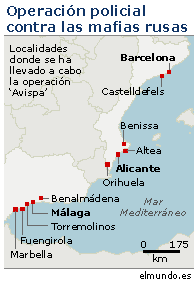
Shortly before his death Litvinenko tipped off Spanish authorities on several organised crime bosses with links to Spain.
During a meeting in May 2006 he allegedly provided security officials with information on the locations, roles, and activities of several "Russian" mafia figures with ties to Spain, including Izguilov, Zahkar Kalashov, and Tariel Oniani.[75]
Other allegations
In his book Gang from Lubyanka, Litvinenko alleged that Vladimir Putin during his time at the FSB was personally involved in protecting the drug trafficking from Afghanistan organized by Abdul Rashid Dostum.[76] In December 2003 Russian authorities confiscated over 4000 copies of the book.[77]
Litvinenko commented on a new law that "Russia has the right to carry out preemptive strikes on militant bases abroad" and explained that these "preemptive strikes may involve anything, except nuclear weapons," Litvinenko said that "You know who they mean when they say 'terrorist bases abroad'? They mean us, Zakayev and Boris, and me.".[25] He also said that "It was considered in our service that poison is an easier weapon than a pistol." He referred to a secret laboratory in Moscow that still continues development of deadly poisons, according to him.[78]
In an article written by Litvinenko in July 2006, and published online on Zakayev's Chechenpress website,
he claimed that Vladimir Putin is a paedophile.[79] Litvinenko also claimed that Anatoly Trofimov and Artyom Borovik knew of the alleged paedophilia.[80]
The claims have been called "wild",[39] and "sensational and unsubstantiated"[81] in the British media. Litvinenko made the allegation after Putin kissed a boy on his belly while stopping to chat with some tourists during a walk in the Kremlin grounds on 28 June 2006.[81]
The incident was recalled in a webcast organised by the BBC and Yandex, in which over 11,000 people asked Putin to explain the act, to which he responded, "He seemed very independent and serious... I wanted to cuddle him like a kitten and it came out in this gesture. He seemed so nice...There is nothing behind it."[82] It has been suggested that the incident was a "clumsy attempt" to soften Putin's image in the lead-up the 32nd G8 Summit which was held in Saint Petersburg in July 2006.[81]
http://en.wikipedia.org/wiki/Alexander_Litvinenko