Ano lähettää Iranissa asuvan kaverinsa viestiä kaikille seuraajilleen.
AT: -Iranilainen kollegani pyysi jakamaan puheensa!Puheen sisältämä viesti alkuun Suomeksi käännettynä ja sen jälkeen koko puhe englanniksi.
"Viesti maailmalle
Haluan päättää puheeni suoralla viestillä totuutta etsiville kansainvälisille ystävillemme ja kollegoillemme:
Me emme aloittaneet tätä sotaa. Iraniin hyökättiin kahdesti – kesäkuussa 2025 ja uudelleen helmikuussa 2026. Molemmat sodat olivat provosoimattomia ja laittomia.
Olemme osoittaneet pidättyvyyttä. Vaikka meitä vastaan hyökättiin neuvottelujen aikana, vaikka korkein johtajamme kärsi marttyyrikuoleman virka-asemassaan paastotessa ramadanin aikana, vaikka tuhannet siviilimme ovat kuolleet – olemme jatkaneet diplomaattisten ratkaisujen etsimistä.
Haluamme rauhaa. Mutta emme nöyryytykseen perustuvaa rauhaa. Rauhaa, joka perustuu keskinäiseen kunnioitukseen, yhtäläisiin oikeuksiin ja sen tunnustamiseen, että Iranin kansa ei taipu paineen alla.
Valinta ei ole yksin meidän.
Toisen osapuolen on valittava: aito diplomatia vai sodan jatkuminen. Kahden viikon tulitauko on mahdollisuus. Tuleeko siitä todellinen rauha vai vain tauko ennen lisää verenvuodatusta, riippuu teoista, ei sanoista.
Maailman tulisi seurata tilannetta tarkasti. Tarkkaile, kuka pitää lupauksensa ja kuka rikkoo ne. Tarkkaile, kuka iskee siviileihin ja kuka puolustaa heitä. Tarkkaile, kuka pyrkii rauhaan ja kuka tuhoon.
Iranin kansa seuraa myös tilannetta. Ja he muistavat."
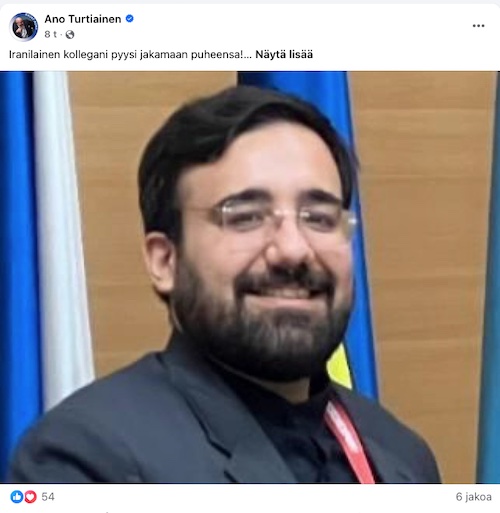
- VKK_Ano_Iran_kollega.jpg (63.09 KiB) Katsottu 321 kertaa
# Understanding the Iran-US Ceasefire: A Comprehensive Q&A for International Friends and Journalists
Prepared by: Reza Ahadi Shahri
Date: April 9, 2026
Context: Following the announcement of a two-week ceasefire between Iran and the United States, brokered by Pakistan
## Introduction
Dear friends and colleagues,
Many of you have asked me the same questions about the ceasefire, Iran's position, the 10-point plan, and what happens next. Rather than repeating myself, I have prepared this comprehensive document. What follows is not a diplomatic statement or media spin. It is an honest assessment based on documented history, battlefield realities, and the lived experience of the Iranian people.
I have organized this as a Q&A covering the most important questions. Feel free to share this document in full or in parts with anyone seeking to understand what is really happening.
## 1. Israel Has a Long History of Breaking Ceasefires
Q: Why doesn't Iran trust this ceasefire?
A: Because Israel has a documented, systematic pattern of violating ceasefires. This is not about politics or propaganda. These are facts documented by the United Nations, international monitors, and even Israeli officials themselves.
Let me give you three clear examples:
### Lebanon Ceasefire (November 27, 2024 – Present)
The ceasefire agreement with Lebanon required Israel to halt "offensive" military actions. Instead, according to the United Nations Interim Force in Lebanon (UNIFIL), Israel has committed more than 10,000 air and ground violations inside Lebanese territory since the truce was announced. UNIFIL has documented over 7,500 airspace violations and nearly 2,500 ground violations north of the Blue Line. [Source: [Frontline](
https://frontline.thehindu.com/.../article70837607.ece)]
The Lebanese Ministry of Health reports that as of November 2025, Israeli violations have resulted in 331 deaths and 945 injuries. According to the same data, Israel has launched 669 airstrikes in Lebanon during the ceasefire period. The Israeli army itself acknowledged violating the agreement, admitting it carried out "1,200 focused operations in southern Lebanon" during the ceasefire year.
Most recently, on April 8, 2026 – the same day the Iran-US ceasefire was announced – Israel launched a massive operation ("Eternal Darkness") against Lebanon, killing at least 112 people. Prime Minister Netanyahu explicitly stated that the ceasefire with Iran "does not cover Lebanon." [Source: [Frontline](
https://frontline.thehindu.com/.../article70837607.ece)]
### Gaza Ceasefire (October 2025 – Present)
The situation in Gaza is no different. According to one count, Israel violated the Gaza ceasefire agreement 591 times between October 10 and December 2, 2025, using a combination of air and artillery attacks and direct shootings. During this period, 347 Palestinians were killed and 889 injured. In another documented period, Hamas listed 47 Israeli breaches resulting in 38 martyrs and 143 injuries. [Source: [BBC](
https://www.bbc.com/news/articles/c5y6y6k4gkgo)]
### What This Pattern Means
The pattern is consistent and undeniable: Israel uses ceasefires not to end conflicts, but to create "no war, no peace" situations where it maintains the right to strike whenever it wants while its adversaries are expected to remain bound by the agreement. As one international security scholar put it, "They [Israelis] don't want to resolve the conflict. War is the new norm".
This is the context in which Iran approaches any ceasefire agreement. We have learned from bitter experience that Israeli commitments are tactical pauses, not strategic peace.
## 2. America Has Also Repeatedly Broken Its Word
Q: What about America? Has the US honored its agreements with Iran?
A: No. The pattern of American bad faith is as clear as Israel's.
### June 2025: The 12-Day War
The 12-Day War erupted on June 13, 2025, when Israel launched a surprise bombing campaign against Iran's nuclear and military facilities. At the time, we were in active nuclear negotiations with the Americans through Omani mediation. The sixth round of US-Iran nuclear talks was scheduled for Sunday, June 15, in Oman.
On the morning of June 13, while negotiations were ongoing, Israel attacked. Iran cancelled the talks. Foreign Minister Abbas Araghchi confirmed to Al Jazeera that "the next round of talks in Oman on Sunday will not go ahead". Iran's position was clear: dialogue was "meaningless" while barbarous attacks targeted the nation. [Source: [GlobalSecurity](
https://www.globalsecurity.org.globalse ... rg/.../ira...)]
What did Trump say about this? He called the Israeli attacks on Iran "excellent". The United States claimed it was not complicit, but the message was unmistakable: America was negotiating with one hand while blessing Israeli strikes with the other.
Foreign Minister Araghchi later recalled that five previous rounds of negotiations were cut short following attacks on Iran's nuclear facilities by Israel and subsequently the United States.
### February-March 2026: The Ramadan War
The most recent betrayal is still fresh. On February 28, 2026 — the first day of Ramadan — a US-Israeli missile struck the office of Iran's Supreme Leader, Ayatollah Seyyed Ali Khamenei, in Tehran, assassinating him while he was fasting and reciting the Holy Qur'an. The strike was based on the assumption that eliminating the head of state would cause the government to capitulate. It did not.
Here is what the world must understand: we were negotiating with the Americans one day before the Ramadan War began. The attacks happened while talks were ongoing. Again.
### What This Pattern Means
The message from Washington is consistent: negotiation is a tool to buy time, not a genuine search for peace. Every time Iran shows flexibility or positivity, the American side reverts to the rhetoric of "regime change".
This is why our distrust is not emotional. It is rational. It is based on repeated, documented betrayals.
## 3. Iran Has Defended Itself Honorably
Q: How has Iran performed militarily in this war?
A: Despite facing the world's most powerful military alliance, Iran has defended itself with dignity and effectiveness.
Here are documented achievements from the 40 days of war:
- Strategic Deterrence Maintained: Despite claims of "complete destruction," Iran continued to launch regular and deterrent responses throughout the conflict. While Pentagon officials claimed 90% of Iranian weapons factories were destroyed, Iran's ability to respond was never eliminated.
- US Warships Forced to Retreat: Iranian operations shattered the dominance of US warships in the region. Multiple American naval assets were forced to return or reposition. The psychological impact of Iran's demonstrated capability has been significant.
- Advanced Fighter Jets and Drones Destroyed: Iran's air defenses successfully engaged multiple advanced US aircraft. According to official Pentagon data, 13 US service members have been killed and at least 365 wounded in the Iran war so far. [Source: [Daily Times](
https://dailytimes.com.pk/.../pentagon- ... 365-us.../)] Multiple American aircraft — including F-15E Strike Eagles and A-10 Warthogs — were lost in just over a month of combat.
- US Bases in Gulf Countries Hit: Iran struck important US bases in Persian Gulf countries that were used to attack Iran. One strike on a building housing Oracle Corporation in Dubai occurred when interception debris fell on the structure.
Failed US Rescue Operation: The last major US operation to rescue a downed pilot faced major failure. One F-15E crew member remains missing deep inside Iranian territory. US helicopters involved in the rescue were hit by Iranian fire, though all personnel on board survived. The Pentagon admitted it does not know the missing service member's location.
### The Human Cost
War always has a terrible human cost. On the Iranian side, approximately 3,000 people — including soldiers, civilians, young children, and women — have been martyred in this imposed war. War crimes have been documented, including the destruction of civilian infrastructure such as bridges, schools, and residential areas. According to Iranian authorities, more than 26,500 people have been wounded.
### The Spirit of the Iranian People
Despite this suffering, the Iranian people appeared different. They were resistant, passionate, and epic. They were not afraid.
For forty nights, in the streets of Tehran and other cities, with the Iranian flag raised high, the people shouted one word: "Revenge, revenge." [Source: [Times of India](
https://toi.timesofindia.indiatimes.com ... 103752.cms)] Even BBC — not a network known for pro-Iranian coverage — reported on the defiance of Tehran's streets under bombardment.
This is the reality the Western media does not show you: a nation united, not broken.
## 4. Why Iran Accepted This Ceasefire
Q: If you don't trust the other side, why accept a ceasefire now?
A: This is a fair question. The answer lies in Pakistan's unique position and Iran's respect for its neighbor — combined with hard-headed strategic calculation.
### Pakistan's Complicated Position
Pakistan has a complex relationship with the United States. It has special cooperation with Washington, extensive borders with Iran, the atomic bomb, and financial security agreements with Saudi Arabia. These are facts, not judgments.
Pakistan's role as mediator placed Iran in a difficult position. On one hand, there is the respect for neighborliness, friendship, and shared Islamic brotherhood. On the other hand, there are the complicated political and security conditions of Pakistan's relations.
### Iran's Honest Calculation
Let me be completely transparent: Iran knows that Israel and America are reneging on their promises and are not adhering to this ceasefire. We know this from history. We know this because in the two days since the ceasefire was announced, they have already broken their word.
We also know what our people want. The people in the streets want nothing but revenge. They prefer an honorable war at any cost — even losing their lives — to humiliation.
But out of respect for our Pakistani brothers, we agreed to give diplomacy two weeks. The battlefield would pause for two weeks to create space for diplomacy.
### Pakistan's Role in Iran's Post-War Future
However, there is more to this calculation than just brotherly respect. Pakistan's influence for Iran in the post-war future is greater than before the Ramadan War.
Iran will need to divert some of its essential goods imports to Pakistan. Pakistan can serve as a mediator in improving Iran-Saudi Arabia relations. Defense cooperation with Turkey and Saudi Arabia — in the face of Israeli-Emirati threats — may increase, and Pakistan has an important role in this balancing act.
I am not saying this is right or wrong. I am simply explaining the logic of Iranian policymakers: respect for Pakistan today is an investment in a more stable regional environment tomorrow.
### A Final Point on the Ceasefire Timing
Some analysts have noted that the two-week ceasefire resets the 60-day clock under the US War Powers Resolution. The law requires the US president to withdraw forces within 60 days unless Congress authorizes continued military action. The 60-day deadline was approaching. Now, if fighting resumes, President Trump will have another full 60-day window without needing Congressional approval. [Source: [SCMP](
https://www.scmp.com/.../us-ceasefire-iran-sets...)]
Iran is fully aware of this legal maneuver. We entered the ceasefire with our eyes open, understanding the risks. Our decision was based on respect for Pakistan and long-term strategic calculation, not naivety.
## 5. The 10-Point Plan and the First Violations
Q: What is the 10-point plan, and has it already been violated?
A: The 10-point plan is Iran's framework for ending the war. It has been presented to mediators and, according to President Trump himself, accepted as a "basis for negotiation." Trump wrote on Truth Social that "many of the 15 points" of America's plan have been agreed to, but also acknowledged that Iran's 10-point response would be the basis for talks.
The 10 points include:
1. US guarantees not to attack Iran
2. Security agreement for the Strait of Hormuz with Iranian management role
3. Recognition of Iran's right to uranium enrichment
4. Lifting of all primary US sanctions
5. Lifting of all secondary US sanctions
6. Annulment of UN Security Council resolutions against Iran
7. Annulment of IAEA Board of Governors resolutions against Iran
8. Payment of war reparations to Iran
9. Withdrawal of US combat forces from the region
10. Cessation of war on all fronts, including Lebanon
Within 48 hours of the ceasefire being announced, three of these points were already violated:
1. Continued Israeli attacks on Lebanon — Israel launched massive airstrikes on Lebanon, killing at least 112 people, despite Iran's clear condition that the ceasefire must apply to the entire resistance front, including Lebanon. Prime Minister Netanyahu himself clarified that the ceasefire "does not cover Lebanon". Pakistan's Prime Minister Shehbaz Sharif had explicitly said the ceasefire applied "in all areas, including Lebanon." [Source: [Frontline](
https://frontline.thehindu.com/.../article70837607.ece)]
2. Violation of Iran's airspace — A hostile drone entered Iran's airspace multiple times after the ceasefire was supposed to take effect.
3. Denial of enrichment rights — While Iran's Persian-language media reported that the US had accepted Iran's right to enrichment, the English version of announcements omitted this phrase entirely. The US has not formally recognized this right.
This is why Speaker of the Iranian Parliament Mohammad Bagher Ghalibaf said: "The same 'acceptable basis for negotiation' has been openly and clearly violated, even before negotiations have begun. Under these conditions, a two-way ceasefire or negotiations are not reasonable."
He was right. The ceasefire was violated before it even properly started.
## 6. Where Things Stand Now
Q: So is the ceasefire holding? What happens next?
A: As of today, the ceasefire is technically in effect but has already been seriously damaged.
### The Current Situation
- Israel continues to attack Lebanon despite the ceasefire terms
- Iran's airspace has been violated
- Talks are scheduled to begin in Islamabad on April 11
- Pakistan is calling on both sides to maintain the ceasefire
- Iran is keeping its promise "according to Muslim tradition and the religious teachings of Islam" — even though it is to our detriment
### What Iran Is Doing
We are keeping our promise. This is not weakness. This is adherence to our principles. We believe that if we break our word because the other side breaks theirs, we become like them.
The Iranian government — despite being fully confident that Israel and America are reneging on their promises and not adhering to this ceasefire — is honoring its commitment out of respect for the Pakistani brothers who mediated it.
### What Comes Next
Two weeks. That is the window. If the other side uses this time genuinely to pursue peace, perhaps something can be achieved. If they use it, as they have in the past, to regroup and strike harder — then the Iranian people will have their answer, and the response will be what the streets have been demanding for forty nights.
The Iranian people are not afraid. They have shown this night after night. They prefer honorable resistance to humiliating surrender. And they are ready for either path — peace based on dignity, or war based on principle.
## Conclusion: A Message to the World
I want to close with a direct message to our international friends and colleagues who seek the truth:
We did not start this war. Iran was attacked twice — in June 2025 and again in February 2026. Both wars were unprovoked and illegal.
We have shown restraint. Despite being attacked during negotiations, despite our Supreme Leader being martyred in his office while fasting during Ramadan, despite thousands of our civilians killed — we have continued to pursue diplomatic solutions.
We want peace. But not peace based on humiliation. Peace based on mutual respect, equal rights, and the recognition that the Iranian nation will not bow to pressure.
The choice is not ours alone. The other side must choose: genuine diplomacy, or continued war. The two-week ceasefire is an opportunity. Whether it becomes a real peace or just a pause before more bloodshed depends on actions, not words.
The world should watch closely. Watch who keeps their promises and who breaks them. Watch who targets civilians and who defends them. Watch who seeks peace and who seeks destruction.
The Iranian people will be watching too. And they will remember.
 Kiitos ja anteeks
